
If you have ever sat in a meeting where someone says "our users want X" without any evidence to back it up, you already understand the problem user personas are meant to solve.
A lot of businesses build websites, apps, and marketing campaigns based on assumptions about their audience. Sometimes those assumptions are close enough. Often they are not, and the result is a user experience that looks good on paper but does not convert, retain, or satisfy the people it was built for.
User personas fix this by forcing everyone, from designers to marketers to founders, to design and make decisions around real user behavior instead of internal opinions. Done well, personas are one of the simplest tools for improving UX design and, by extension, your conversion rate. Done poorly (or based on guesswork), they become a slide in a deck that nobody ever looks at again.
This guide walks through what user personas actually are, how to build them properly, and how to make sure they get used rather than filed away.
What Are User Personas and Why They Matter
A user persona is a semi-fictional profile that represents a segment of your real audience, built from actual research into their behaviors, goals, frustrations, and decision-making patterns. It is not a marketing avatar built from guesses about age and income. It is a working model of how a specific type of user thinks, what they are trying to accomplish, and what gets in their way.
Personas matter because they give teams a shared, evidence-based reference point. Instead of debating what "the user" might want, a UX designer, a copywriter, and a marketing manager can look at the same persona and design toward the same goals.
For businesses focused on conversion rate optimization, personas are especially valuable. Every CRO decision, from what headline to test to how a checkout flow should be structured, is stronger when it is grounded in a real understanding of who is actually on the page and what they need to feel confident taking action.
The Difference Between Marketing Personas and UX Personas
It is worth clarifying this early, because the two are often confused.
Marketing personas tend to focus on demographics, buying triggers, and messaging preferences. They help answer, "who should we target and what should we say to them?"
UX personas focus more on behavior, tasks, and friction. They help answer, "how does this person actually use our website or product, and where do they struggle?"
You do not need two completely separate documents, but a persona built purely for ad targeting will usually leave out the behavioral detail that a designer or CRO specialist actually needs. If your goal is better UX design and better conversion outcomes, your personas need to include both the "who" and the "how."
Step 1: Start With Real Data, Not Assumptions
The single biggest mistake in persona creation is starting from opinion instead of evidence. If your personas are built in a brainstorming session with no data behind them, you are effectively formalizing your team's biases and calling it research.
Before you write a single persona, gather information from sources such as:
- Website and app analytics (behavior flow, drop-off points, device and traffic source data)
- Customer support tickets and chat transcripts
- Sales call notes or CRM data
- Existing customer surveys or NPS feedback
- Search query and keyword data showing what people are actually looking for
This data does not need to be perfect. It needs to be real. Even a modest amount of actual user data will produce a far more useful persona than an unlimited amount of guessing.
Step 2: Choose Your Research Methods
Once you know what existing data you have, decide where the gaps are and how you will fill them. Common research methods include:
- User interviews. One-on-one conversations with real users or customers, focused on their goals, frustrations, and decision-making process rather than opinions about design.
- Surveys. Useful for validating patterns at scale once you have some qualitative insight to build questions around.
- Usability testing. Watching real users attempt tasks on your website reveals friction points that no interview will surface on its own.
- Session recordings and heatmaps. These show you what people actually do, as opposed to what they say they do, which are often two different things.
- Competitor and industry research. Helpful for context, but should never replace direct research into your own audience.
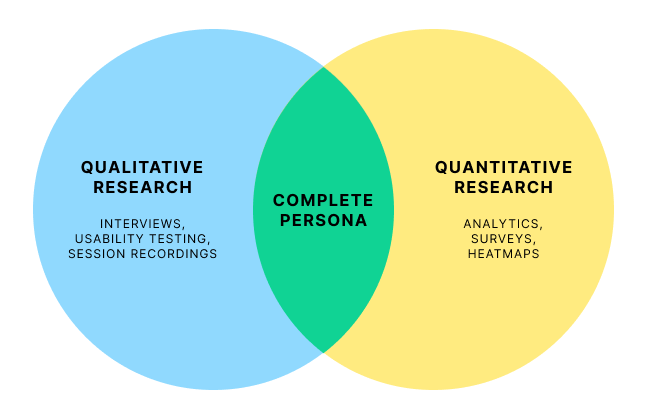
A blended approach, combining qualitative insight (the "why") with quantitative data (the "how many" and "how often"), consistently produces stronger personas than relying on one method alone.
Step 3: Identify Patterns and Segment Your Users
With research in hand, look for patterns rather than trying to capture every individual difference. A persona is meant to represent a meaningful segment of your audience, not one specific person.
Group your findings around things like:
- Shared goals (what are they trying to achieve?)
- Shared frustrations or blockers (what stops them from converting?)
- Shared behaviors (how do they research, compare, and decide?)
- Shared context (what device, channel, or stage of the buying journey are they typically in?)
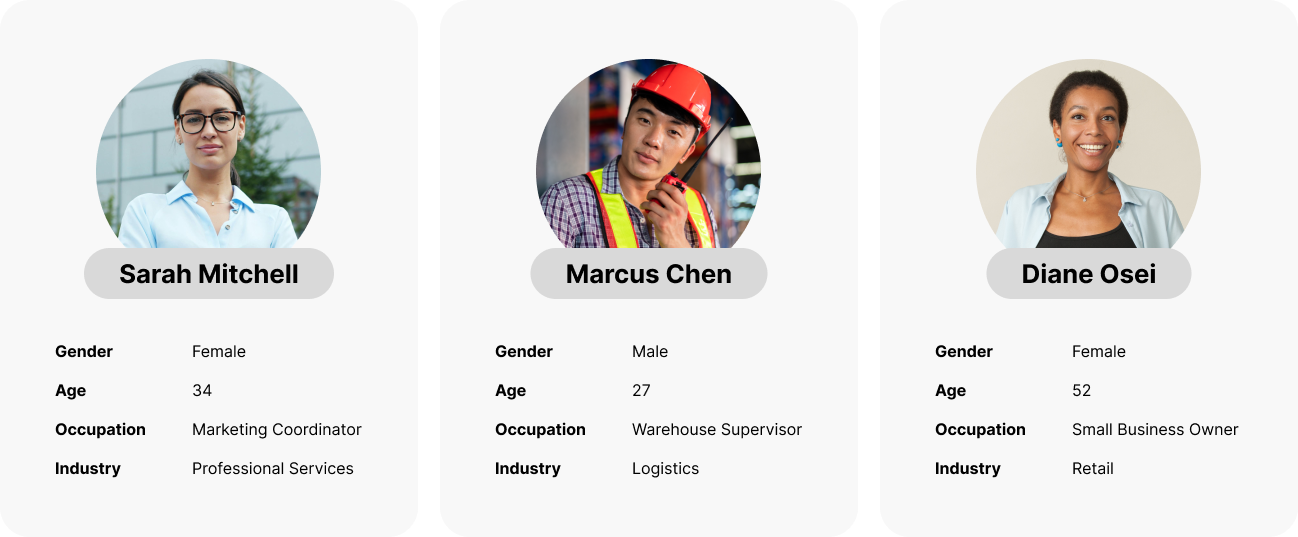
Most businesses end up with somewhere between three and five core personas. If you find yourself with ten or more, you are probably describing individuals rather than patterns, and the personas will become too detailed to be practically useful for design or marketing decisions.
Step 4: Build Out the Persona Profile
Once your segments are clear, put together a simple, usable profile for each one. A good UX persona typically includes:
- Name and role. A memorable name and job title or life context, just enough to make the persona feel real to the team.
- Goals. What is this person trying to accomplish, both on your website and in the broader context of their work or life?
- Frustrations and pain points. What gets in their way, either with your website specifically or with your industry in general?
- Behaviors. How do they research, compare options, and make decisions? Are they price-driven, detail-driven, or trust-driven?
- Preferred channels. Where do they spend time, and how do they prefer to be reached (search, social, email, referral)?
- Objections. What questions or doubts need to be resolved before they will convert?
- A representative quote. A short line, drawn from real research, that captures how this person thinks in their own words.
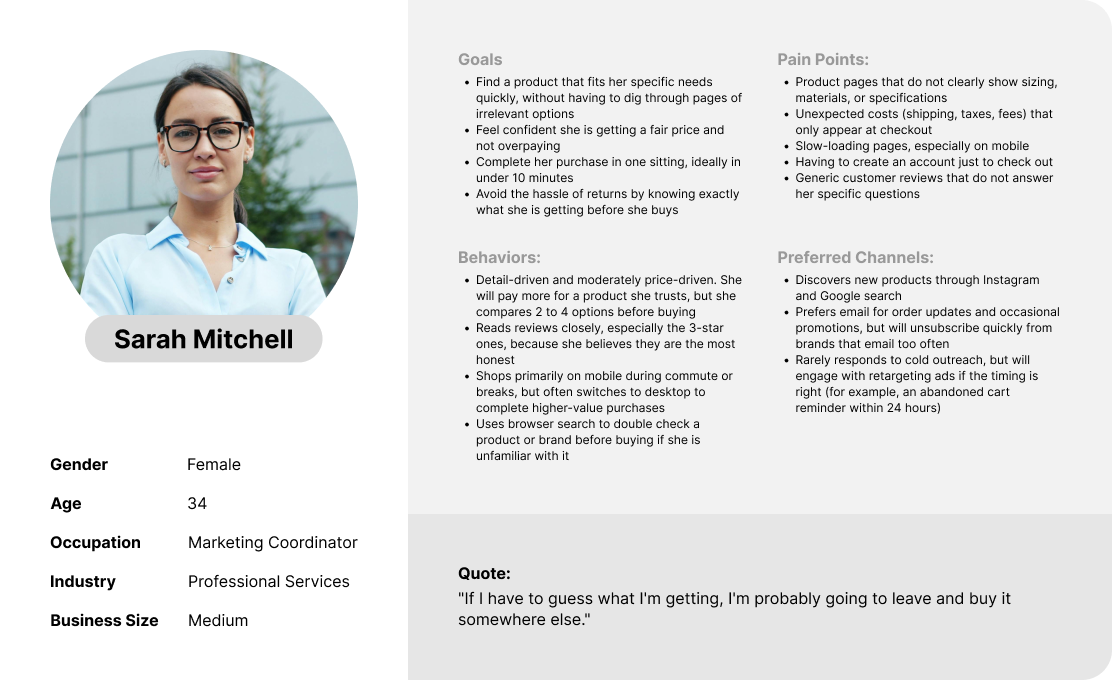
Keep the format simple. A one-page profile that your team actually reads and references is far more valuable than a detailed ten-page document that sits unused.
Step 5: Validate and Test Your Personas
A persona is a hypothesis, not a finished product. Once you have drafted your personas, test them against reality.
- Share them with your sales and support teams and ask if they match the customers those teams talk to every day.
- Use the personas to guide an A/B test or a UX change, then check whether the results match what the persona predicted.
- Revisit analytics periodically to confirm the behaviors you documented are still accurate.
If a persona consistently fails to predict real behavior, it needs to be revised. This is normal and expected. Treating personas as living documents, rather than one-time deliverables, is what separates useful personas from decorative ones.
How to Use Personas to Improve Conversion Rate Optimization
Personas are only valuable if they actually shape decisions. Some practical ways to put them to work:
- Prioritize A/B tests. Instead of testing random ideas, test changes that address a specific persona's known objections or frustrations.
- Guide UX and UI design decisions. Navigation, page layout, and content hierarchy can all be designed around how your primary personas actually behave.
- Improve on-page copy. Write headlines and calls to action that speak directly to a persona's goals and language, not generic marketing phrases.
- Segment your email and paid media campaigns. Different personas often respond to different messaging, offers, and channels.
- Focus user testing sessions. Recruit participants who match your key personas so usability findings are relevant to your actual audience.
This is where personas and conversion rate optimization overlap directly. A test built around a real user need almost always outperforms a test built around a random idea.
Common Mistakes to Avoid When Creating Personas
- Relying only on demographics. Age, gender, and income tell you very little about how someone will behave on your website. Behavior and motivation matter far more.
- Creating personas once and never updating them. Audiences change, and so should your personas.
- Building too many personas. More is not more useful. Focus on the segments that matter most to your business goals.
- Skipping the research phase. A persona built purely from internal opinion is not a persona, it is a guess with a name attached.
- Letting personas sit in a drawer. If your team is not actively referencing personas during design and marketing decisions, they are not doing their job.
How Often Should You Update Your Personas
There is no fixed rule, but a reasonable approach is to review your personas at least once a year, or any time you notice a meaningful shift in your business, such as a new product line, a new market, or a noticeable change in your analytics and customer feedback. If your conversion rates or user behavior start diverging from what your personas predict, that is a clear signal it is time to revisit them.
Tools That Can Help You Build Personas
You do not need expensive software to create effective personas, but a few tools can make the process easier:
- Analytics platforms (such as Google Analytics or similar) for behavioral data
- Heatmap and session recording tools for observing real on-site behavior
- Survey tools for gathering direct feedback at scale
- Simple design tools (such as Figma or Canva) for laying out persona documents your team will actually want to open
The tool matters far less than the quality of the research behind it. That said, most teams already own tools like Google Analytics or a heatmap platform and are only using a fraction of what they offer. If your team has access to these tools but is not confident getting persona-relevant insights out of them, our tool training sessions are worth a look. We walk your team through the platforms you already pay for so you can pull real behavioral data yourselves, rather than guessing at what the numbers mean.
Final Thoughts
Creating user personas is not a box-ticking exercise. Done properly, it is one of the most practical steps you can take toward better UX design and stronger conversion rates, because it replaces internal guesswork with a shared understanding of who your users actually are and what they actually need.
If you are not sure where to start, or you have personas that were built years ago and never updated, that is a common starting point and an easy one to fix.
Want help building personas that actually drive results? Book a free consultation with our team and we will walk you through how to turn real user research into UX and conversion improvements that make a measurable difference.
Book a Free Website Consultation
Discover quick wins for your digital strategy. 100% guaranteed.