Seven out of ten shoppers who add something to their cart never buy it. That is not a rounding error, it is the average outcome of nearly every ecommerce checkout on the internet. Baymard Institute's meta analysis of 50 independent studies puts the global cart abandonment rate at 70.22 percent as of its September 2025 update, and that number has barely moved in a decade despite a mountain of "best practice" advice telling brands otherwise.
The good news: most of that lost revenue is not gone, it is parked. Baymard estimates roughly 260 billion dollars in orders across the US and EU alone are recoverable through better checkout design and follow up, not new traffic. That is the mission this guide is built around: not just what abandoned cart recovery tactics exist (we already covered that ground in our 10 Smart Strategies For Ecommerce Abandoned Cart Recovery), but exactly how to sequence them so they actually convert.
The Real Cost of Abandoned Carts
A 70.22 percent abandonment rate means for every 100 shoppers who add a product to cart, roughly 30 complete checkout and 70 walk away. Mobile makes it worse: data reported by Ringly.io (citing Dynamic Yield, 2025) shows mobile abandonment sitting around 80 percent compared to about 66 percent on desktop, a gap that has not meaningfully closed even as mobile commerce has grown.
Recovery is not a nice to have line item, it is one of the highest leverage moves available to an ecommerce team because the traffic and intent already exist. You are not paying to acquire these shoppers again, you are paying to bring back people who already picked a product, added it to cart and got interrupted before checkout.
Why Shoppers Abandon Carts Before They Hit Buy
Baymard Institute's 2026 survey of 1,083 US online shoppers breaks down the actionable reasons shoppers bail, once you exclude the 42 percent who were just browsing with no real purchase intent:
- Extra costs at checkout. 40 percent of shoppers abandon when shipping, taxes, or fees show up unexpectedly at the last step. This is the single largest fixable cause.
- Slow delivery. 20 percent walk away when estimated delivery times are longer than they're willing to wait.
- Trust and security concerns. 19 percent don't trust the site enough to hand over their credit card details.
- Forced account creation. 18 percent abandon when a site requires a full account before checkout instead of offering a guest option.
- Checkout that's too long or complicated. 17 percent cite an overly long or complex checkout flow, tied with...
- Site errors. ...another 17 percent who hit outright website errors or crashes during checkout.
Smaller but still notable factors include an unsatisfactory return policy (13 percent), not being able to see the total order cost upfront (12 percent), declined credit cards (10 percent), and too few payment method options (9 percent).
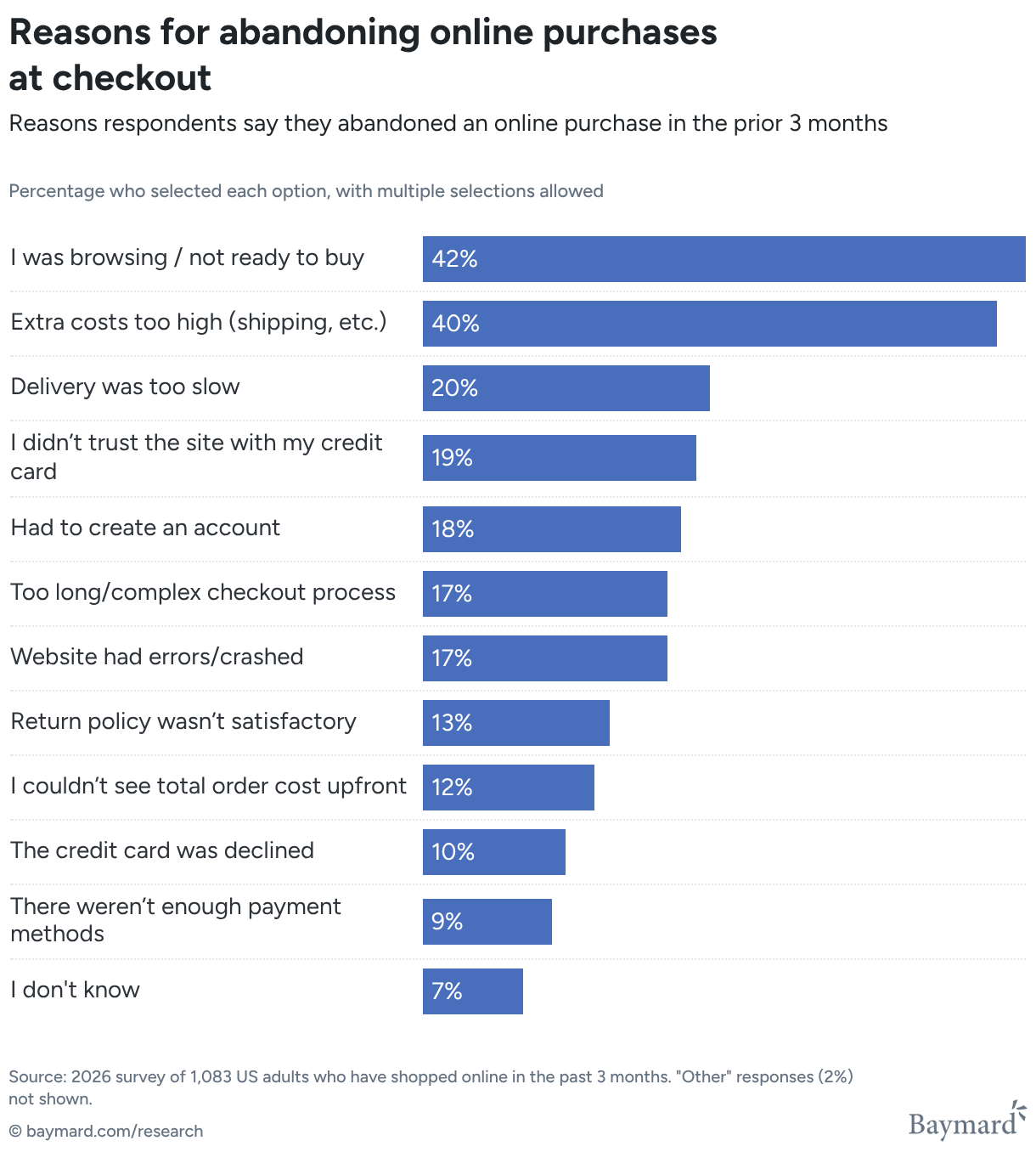
Notice the pattern: most of this is friction and doubt, not disinterest. That is what makes recovery so effective. You are not convincing someone to want the product, you are removing the thing that stopped them from finishing.
10 Smart Strategies That Win Back Sales
These are not exotic tactics. What separates the accounts that recover meaningful abandoned revenue from the ones that barely move the needle is not which tactics they use, it is how precisely they sequence and execute them. Here is the order we prioritize with clients, and why.
1. Cart Recovery Emails, Timed to Intent.
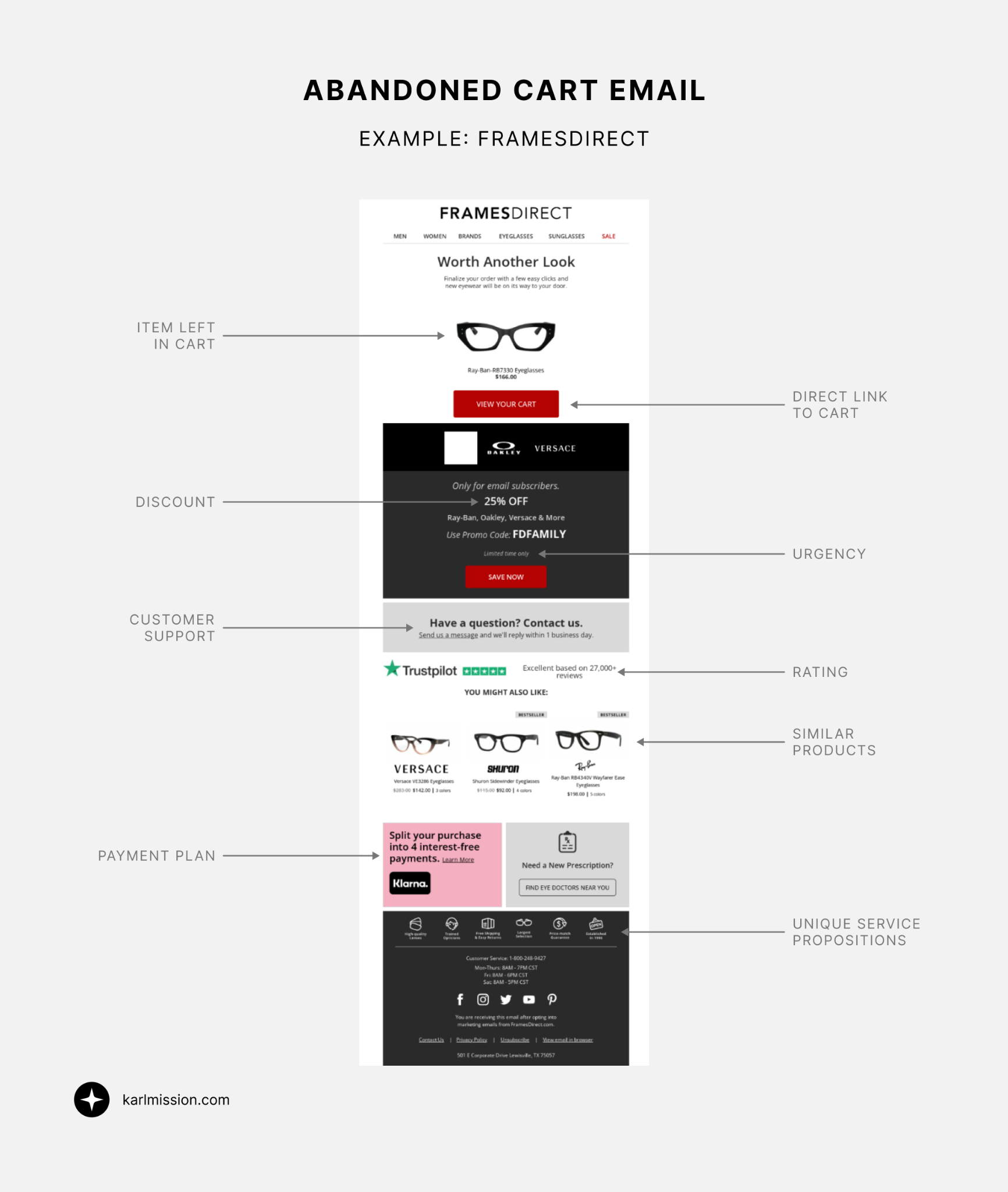
The first email should go out within an hour of abandonment, while intent is still warm. Klaviyo's 2024 benchmark report, based on over 143,000 abandoned cart flows, shows these emails average a 50.5 percent open rate and a 3.33 percent conversion rate. Top-performing brands push that much further, reaching 65.34 percent opens and 7.69 percent conversion, more than double the average.
2. SMS Recovery for High Intent Moments
SMS earns its place for shoppers who opted in, not as a blanket channel. It works best as a second touch, roughly 24 hours after cart abandonment, when email alone has not closed the sale.
3. Exit Intent Offers
A well timed exit intent popup catches the shopper before they leave, not after. Keep the offer modest, a reminder of what is in cart plus a small nudge converts better than a discount that trains shoppers to always wait for one.
4. Incentives and Urgency, Used Honestly
Free shipping thresholds and limited time framing work, but only when they reflect something real. Fabricated countdown timers erode the trust you are trying to rebuild in the same email.
5. Checkout Optimization Fixes
This is where recovery and prevention meet. Cutting form fields, surfacing shipping costs early and adding a progress indicator on multi step checkouts directly reduces the number of carts you need to recover in the first place. This is the core of what ecommerce checkout optimization work actually looks like in practice.
6. Trust Signals at the Moment of Doubt
Secure payment badges, visible return policy and real customer reviews placed near the buy button address the hesitation Baymard's research flags as a top abandonment driver. These small trust signals do a lot of quiet work at exactly the moment a shopper is deciding whether to trust you with their money.
7. Guest Checkout, Always Available
Never make account creation a gate. Offer it after purchase, not before.
8. Mobile Optimization
With mobile abandonment sitting near 80 percent, a checkout that has not been tested on a phone in the last quarter is actively losing sales. Tap targets, autofill and digital wallets (Apple Pay, Google Pay) matter more on mobile than almost any other single fix.
9. Retargeting Ads
Retargeting campaigns that point directly back to the cart, not the homepage, keep the path short. Industry sources consistently report meaningful abandonment reduction and sales lift from well-targeted retargeting, though the exact size of that effect varies widely by category, creative, and platform.
10. Personalization
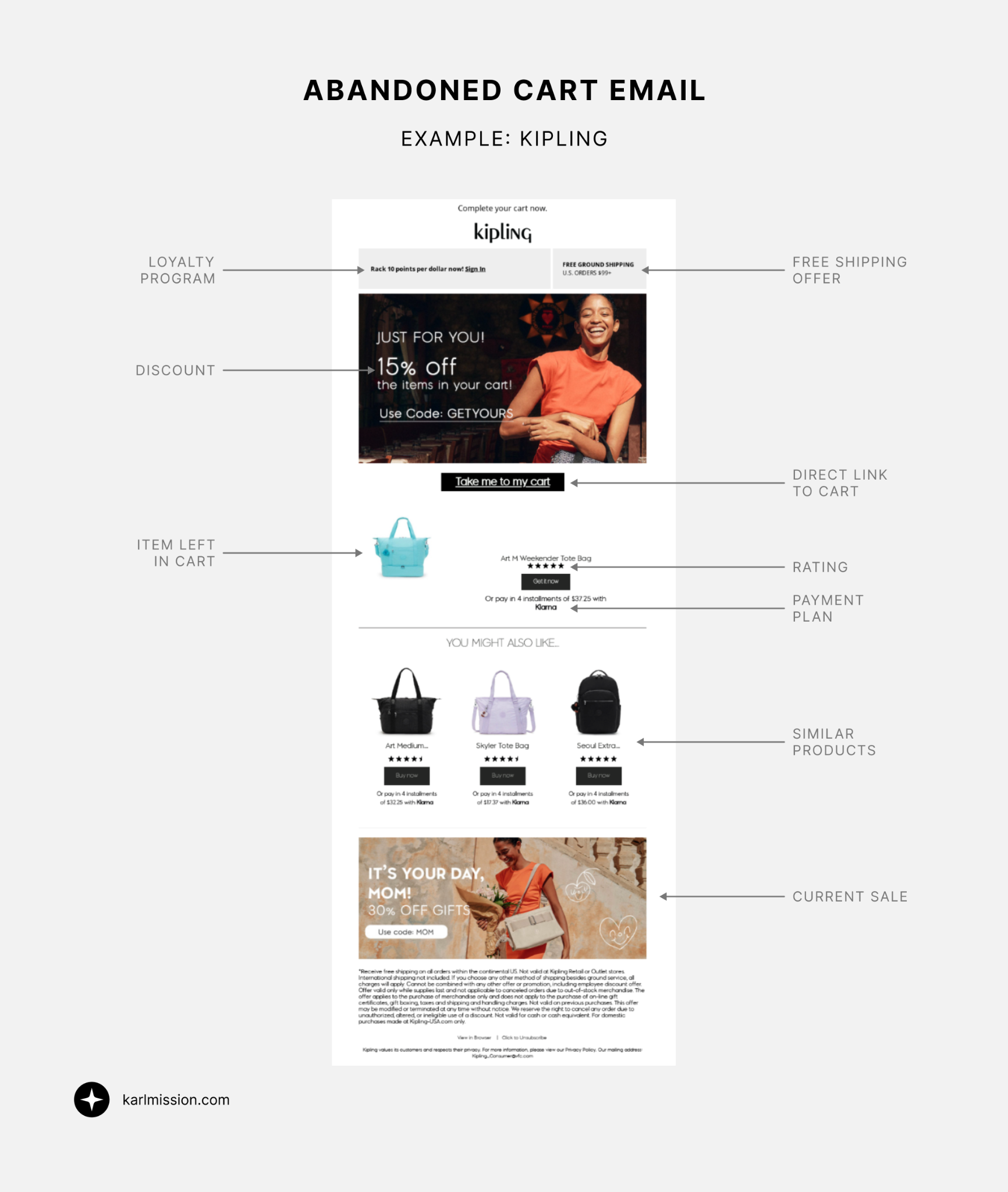
Reference the actual product left in the cart, not a generic "come back" message. Recovery emails that show the item, price and a clear single CTA consistently outperform generic reminders because they remove the extra step of the shopper having to remember what they wanted.
That is ten moving parts, run correctly, at the same time, on top of whatever your team is already managing. If you would rather have someone map this against your actual checkout data than piece it together from a list, book a free session with us and we will walk through where your recovery flow is leaking revenue.
Timing and Sequencing That Actually Convert
Tactics without a cadence are just a list. Here is a sequence we see work consistently across ecommerce accounts:
Hour 1: First recovery email. Simple, product focused, no discount yet. This is the email carrying the bulk of that 50.5 percent open rate window, per Klaviyo's benchmark data.
Hour 24: Second email, paired with SMS if the shopper opted in. Add social proof or a trust signal here, this is often where hesitation, not forgetfulness, is the real blocker.
Hour 72: Final email with a modest, honest incentive if margin allows. This is the point where urgency framing earns its place, because you have already given the shopper two chances to complete the purchase on their own terms.
Beyond 72 hours, returns drop off sharply and the channel shifts from recovery to retargeting. That handoff, from owned channels like email and SMS to paid retargeting, is where a lot of ecommerce teams lose the thread and let a recoverable cart go cold.
How to Reduce Cart Abandonment for the Long Term
Recovery emails treat the symptom. The real compounding gains come from reducing how many carts get abandoned in the first place, and that is a checkout UX problem, not a marketing automation problem. Every fix in the list above, shorter forms, upfront shipping costs, mobile friction removal, should be tested against your actual traffic, not assumed to work because it worked somewhere else.
This is why we treat abandoned cart recovery as an ongoing experimentation program, not a one time email flow setup. Structured A/B testing on checkout flow, form length and offer placement is what turns a 3 percent recovery rate into an 8 to 12 percent one over time, because you are no longer guessing which friction point actually matters to your specific customers.
Frequently Asked Questions
What is a good cart abandonment recovery rate?
Most ecommerce brands recover between 3 and 5 percent of abandoned carts with a basic single email flow, while accounts running a proper multi step email and SMS sequence typically land in the 8 to 12 percent range.
How many recovery emails should I send?
Three emails, spaced across roughly the first 72 hours, is the standard that performs best. Spacing them out this way catches shoppers at different points of hesitation, from the initial reminder to a nudge once the urgency of the moment has faded.
Does SMS recovery work better than email?
SMS is not a replacement for email, it is a high intent second touch. It works best layered in around the 24 hour mark for shoppers who have opted in, adding reach rather than competing with the email sequence.
What's the difference between cart abandonment and checkout abandonment?
Cart abandonment covers anyone who adds a product but never starts checkout, while checkout abandonment is narrower: shoppers who start the checkout process but drop off before completing it. Checkout abandonment is usually the clearer signal of a UX problem, since intent to buy is already confirmed.
Recovery Is Not a Fix, It Is a Mission
Cart recovery emails and SMS flows will get you real revenue back, but they are a patch on top of a checkout that is still losing 70 percent of its traffic by design. The brands that actually close the gap treat abandoned cart recovery the same way they treat every other part of conversion rate optimization: as an ongoing program of testing, measuring and refining, not a flow you set up once and leave alone.
If you want a second set of eyes on where your checkout is actually losing people, and what your recovery sequence should look like once the fixable friction is gone, book a free CRO consultation with our team. No obligation, no sales pitch. Just a practical conversation about your checkout and what's possible.
Book a Free Website Consultation
Discover quick wins for your digital strategy. 100% guaranteed.