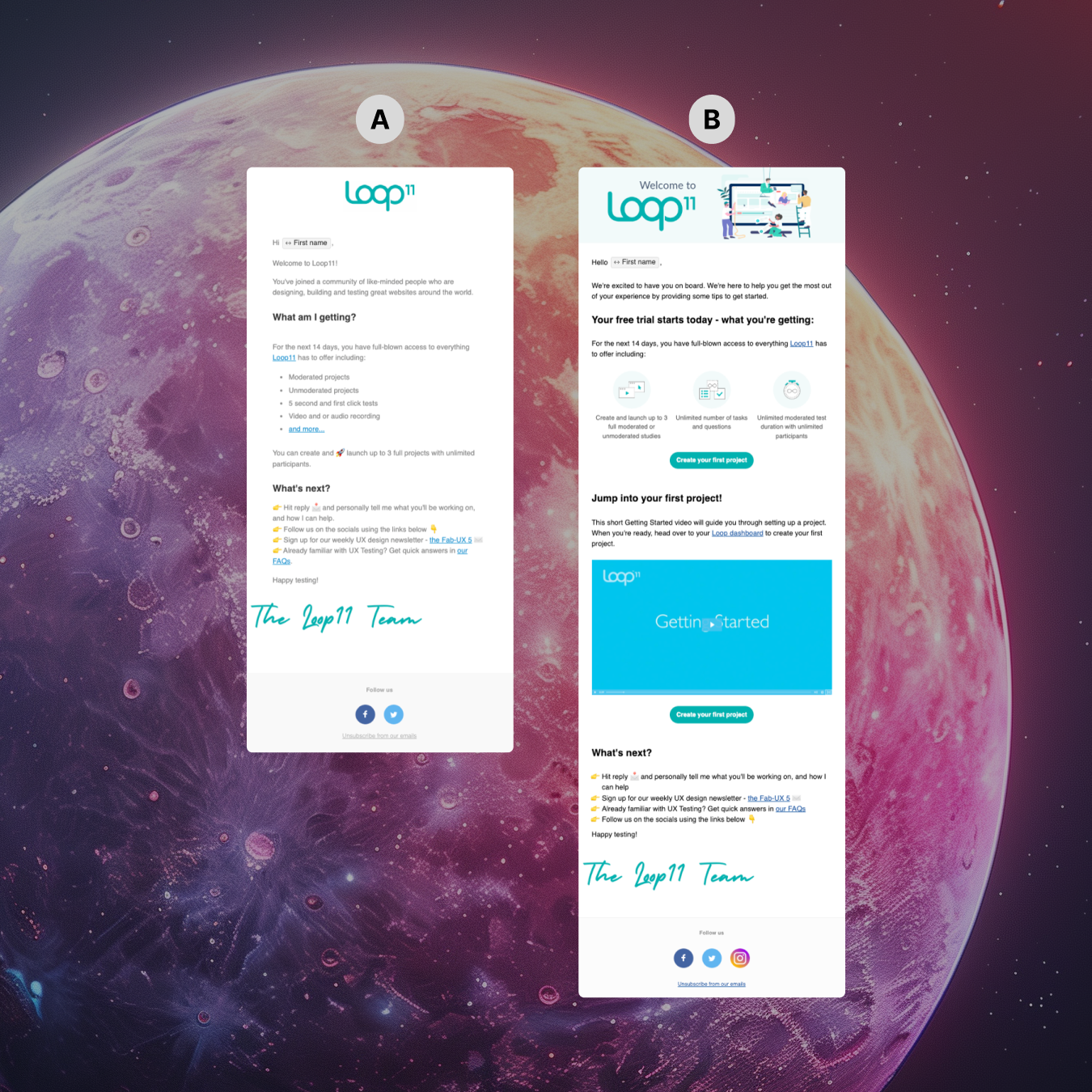
Email marketing is still one of the highest-ROI channels for businesses, but only if your emails actually get opened, read, and clicked. With inbox competition at an all-time high, small changes in your email subject lines, content, and CTAs can dramatically shift performance.
That’s where A/B testing for email campaigns becomes essential. Instead of guessing what will work, you’re making decisions based on real-world user behavior and capturing more conversions with every send.
In this in-depth guide, we’ll break down how to structure email A/B tests, what variables to test, how to analyze results, and common mistakes to avoid. Whether you're a business owner, marketing professional, or website manager, this guide will help you build email campaigns that consistently perform.
Why A/B Testing Matters in Email Marketing
Most marketers stop at “gut feeling” or “industry norms,” but your audience is unique and what works for one brand may fall flat for yours. A/B testing:
- Increases open rates by optimizing subject lines and preview text
- Boosts CTR through better messaging, formatting, and CTA placement
- Improves conversions by aligning offers with audience expectations
- Reduces unsubscribe rates by making content more relevant
- Helps identify what actually influences your users’ behavior
With platforms like Klaviyo, Mailchimp, HubSpot, and ActiveCampaign offering built-in experiment tools, testing is faster and more accessible than ever.
For an overview of foundational A/B testing concepts, you can also explore our guide, Choosing the Right Strategy: A/B Testing vs. MVT Testing.
What You Can A/B Test in Email Campaigns
Below are the most impactful elements you should consider testing. Start with the ones closest to the top of the funnel (“open the email”), then move further down (“convert from the email”).
1. Subject Lines
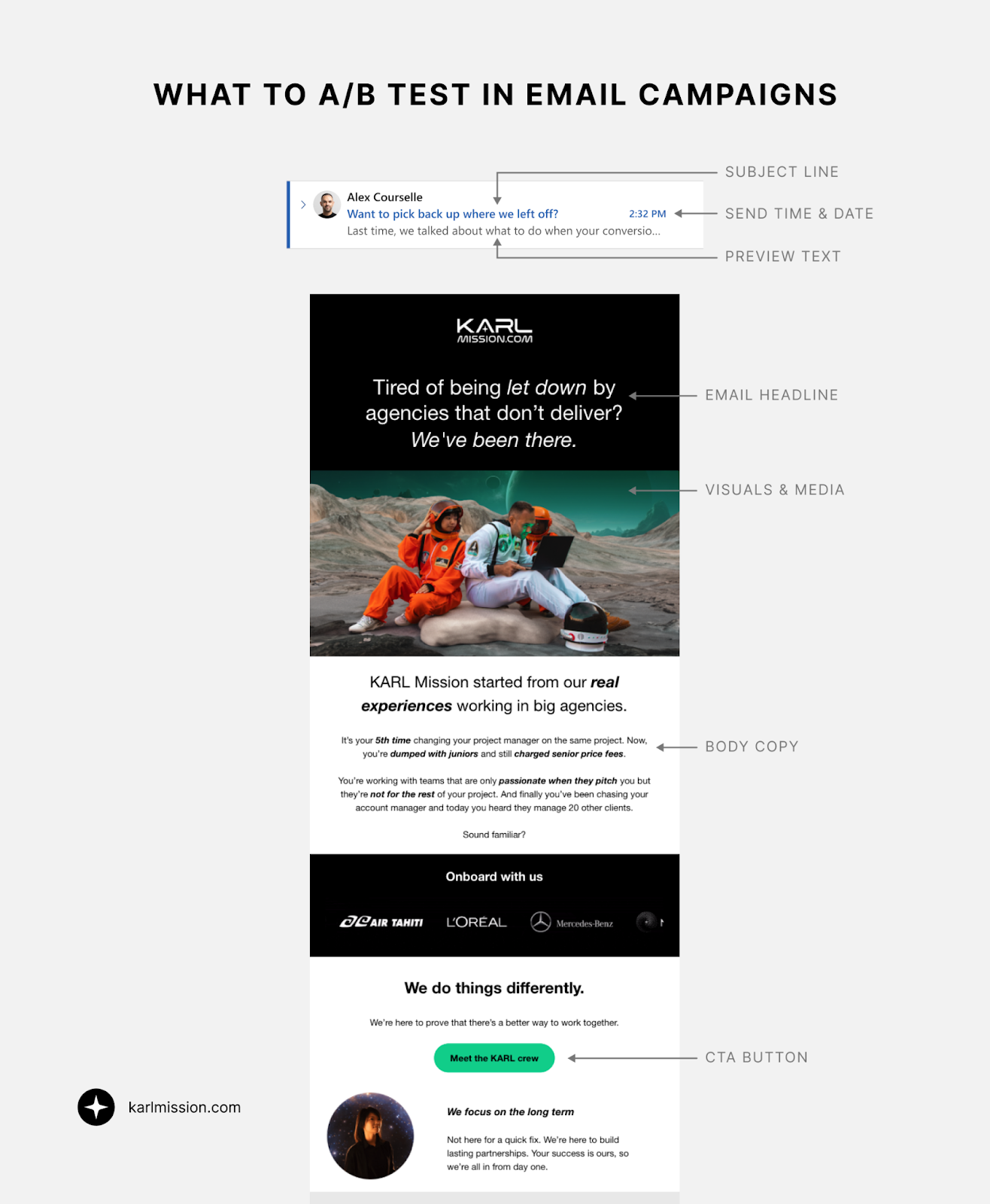
The subject line is your first impression and often the deciding factor in whether a user opens the email. Testing subject lines is one of the fastest ways to improve performance.
What to test:
- Length: short vs long
- Tone: formal vs conversational
- Personalization: “Hi Alex” vs no name
- Urgency: “Last chance,” “Final hours,” “Ends tonight”
- Audience-first wording: “How to improve ___” vs “We’re excited to share…”
- Emoji use: ✨📣⚡ vs none
- Value proposition: % discounts, tips, freebies, insights
Example:
A: “Today Only: 20% Off Everything”
B: “Your Exclusive 20% Discount Inside”
For more inspiration, see 5 Email Marketing Elements to A/B Test, a helpful companion to this guide.
Tips:
- Keep it between 28-50 characters (varies by device)
- Avoid spam triggers like “FREE!!!”
- Make it scannable, people skim inboxes fast
2. Preview Text
Often overlooked, preview text reinforces your subject line and can meaningfully raise open rates.
What to test:
- Complementary vs curiosity-generating preview text
- Personalization
- Short vs long formats
Example:
A: “We’re giving you early access to a new feature.”
B: “Unlock something new today — see inside.”
3. Email Headlines
Once users open the email, the headline determines whether they keep reading.
What to test:
- Value-focused vs benefit-focused messaging
- Direct vs story-driven headlines
- Personalization
- Emojis
- Short vs long lines
Example:
A: “Introducing Our New Dashboard”
B: “Get Insights Faster With Your New Dashboard”
4. Email Body Copy
Your body content can change engagement significantly, especially in long-form newsletters or product announcements.
What to test:
- Length: short and punchy vs longer and educational
- Formatting: bullet points vs paragraphs
- Tone: conversational vs expert vs energetic
- Personalization tokens
- Value proposition placement
- The use of social proof
Example:
A: Focus on features
B: Focus on benefits and outcomes
5. Visuals & Media
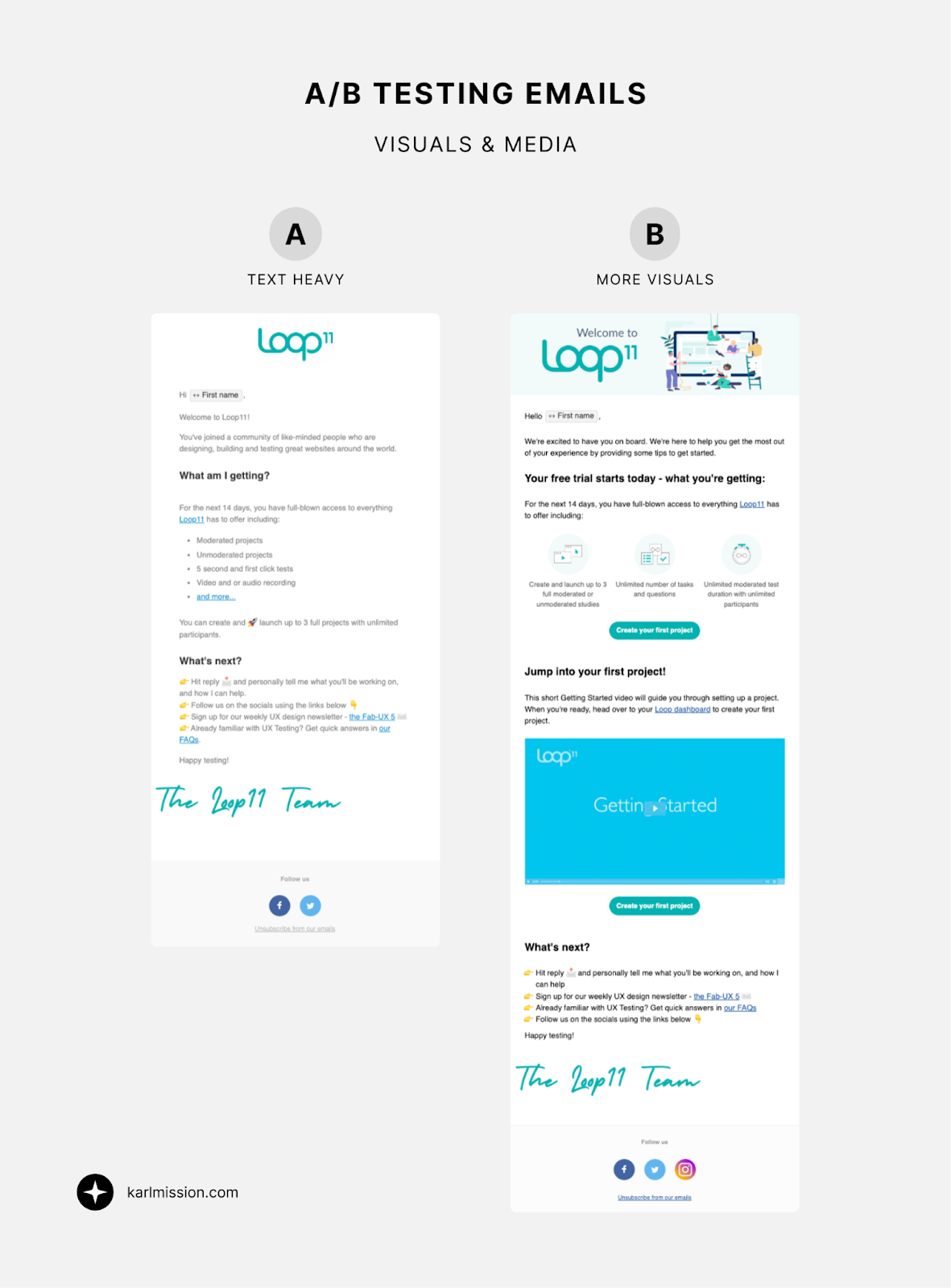
Images can increase or decrease engagement depending on your audience segment.
What to test:
- Graphic-heavy vs text-only formats
- Static images vs GIFs
- Product photography vs illustrations
- Hero image placement
Pro tip: Always check mobile rendering! A surprising number of email designs break on small screens.
6. CTA Buttons
Your CTA is the most direct conversion lever.
What to test:
- Button text
- Button color or contrast
- Size and shape
- Location (top, middle, bottom)
- Multiple CTAs vs one primary CTA
- P.S. link vs no P.S.
- Urgency-driven copy
CTA examples:
- “Start Your Free Trial”
- “See The Product Demo”
- “Download the Guide”
- “Book a Free Consultation” (hint: test both “Book” and “Schedule”)
7. Send Time & Send Day
Even the best email won’t perform if sent at the wrong time.
What to test:
- Morning vs afternoon
- Tuesday/Wednesday/Thursday vs weekends
- Sending by time zone vs sending globally at once
Most industries see strong performance between 9 AM and 1 PM, but always test for your own audience.
8. Audience Segmentation & Personalization
Segmentation often creates the biggest conversion impact with the least work.
What to test:
- New subscribers vs returning customers
- High-intent users vs cold leads
- Location-based segments
- Past purchase behavior
- Engagement level (openers vs non-openers)
How to Structure a High-Quality Email A/B Test
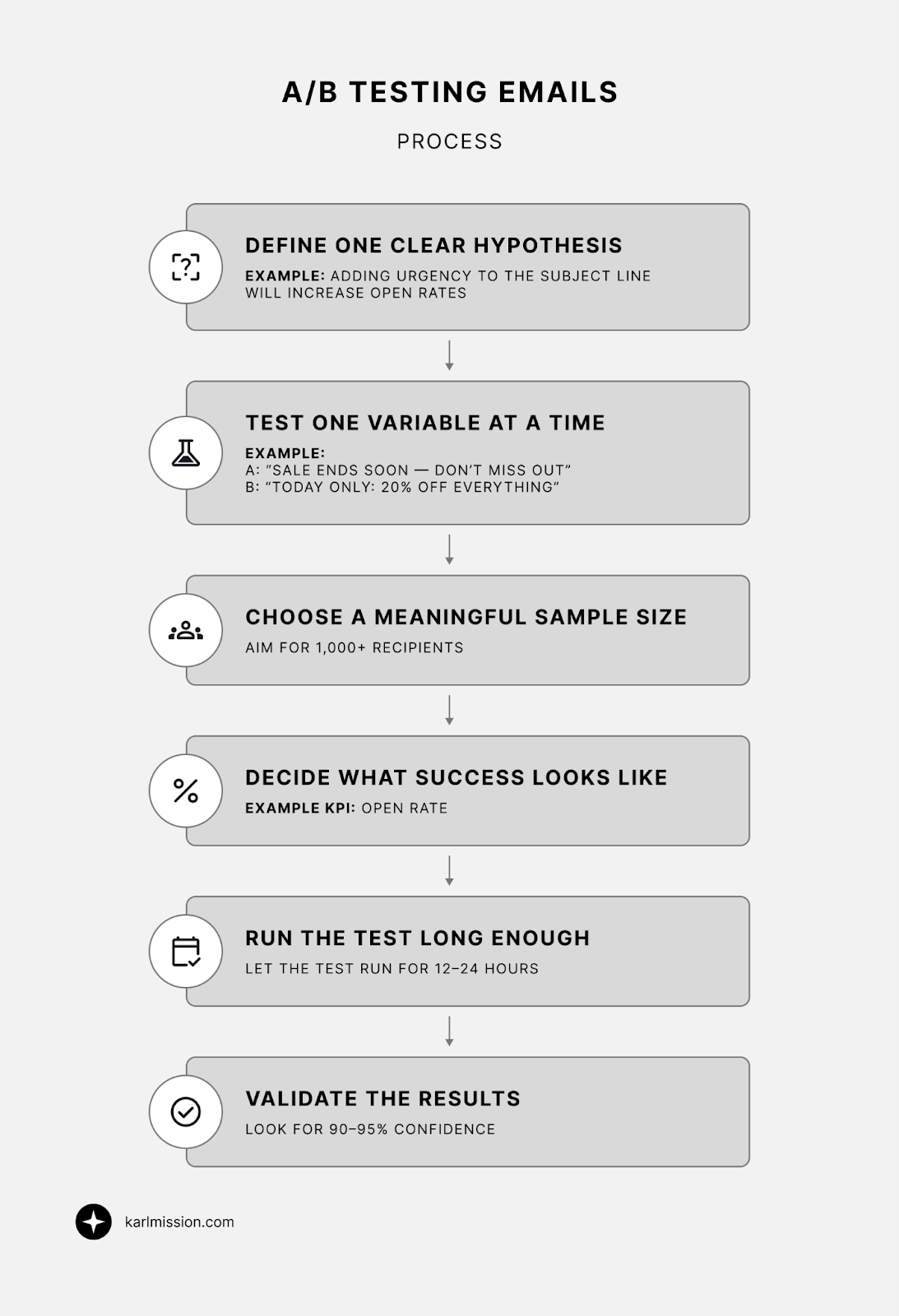
To get meaningful results, avoid testing randomly. Use this simple structure:
1. Define one clear hypothesis
Example:
“Adding urgency to the subject line will increase open rates by 10%.”
A hypothesis keeps your test focused and measurable.
2. Test only one variable at a time
If you test both a new headline and a new CTA, you won't know which change influenced results.
Single-variable testing is the foundation of reliable experimentation.
3. Choose a meaningful sample size
Most email platforms automate this, but as a rule of thumb:
- At least 1,000 recipients = minimum for statistically significant results
- Send to 10-20% test segments, then send the winner to the remaining audience
If your list is smaller than 1,000, treat the results directionally rather than scientifically.
4. Decide what success looks like
Your KPI changes depending on what you’re testing:
- Subject line tests → Open Rate
- Content tests → Click-Through Rate
- Offer/CTA tests → Conversion Rate
- Send times → Total engagement
Make sure your KPI aligns with the variable, and ensure you understand how to interpret these metrics so you can evaluate test results accurately.
5. Run the test long enough
Aim for a 2-48 hour window depending on how quickly your audience typically opens emails. For most brands, 12-24 hours is ideal.
6. Validate the results using statistical significance
Most email platforms automate statistical significance calculations, but remember:
- More data = more reliable
- Small differences are rarely meaningful
- Look for at least a 90-95% confidence level
Common A/B Testing Mistakes to Avoid
Many businesses A/B test incorrectly. Here’s what to avoid:
Testing too many variables at once
This leads to unclear results.
Declaring winners too early
Let the test run the full window.
Testing tiny list sizes
Small samples lead to misleading results.
Not keeping a testing log
Documenting learnings prevents repeated mistakes.
Stopping after one test
Email A/B testing should be continuous and iterative, not one-and-done.
Ignoring qualitative feedback
Heatmaps, surveys, and user testing provide context data cannot.
How to Analyze A/B Test Results Accurately
If your subject line test increased opens by 4%, is that meaningful? It depends.
Here’s how to analyze results properly:
1. Check the sample size
A 4% lift with 10,000 recipients is meaningful.
A 4% lift with 80 recipients? Not so much.
2. Look for clear, directional signals
If results are too close to call, run the test again or test a more extreme variation.
3. Compare across segments
Your email may perform differently for:
- New vs returning customers
- Subscribers vs buyers
- Mobile vs desktop
Sometimes a test “loses overall” but “wins” for a high-value segment.
4. Document the results
Keep a simple log:
- Date
- Variable tested
- KPIs
- Outcome
- Future improvements
Over time, you build a library of insights specific to your brand.
Our Recommended A/B Testing Roadmap for Email Marketing
Here’s the order we usually test for clients:
- Subject lines (quick win)
- Preview text
- Email headlines
- CTA button text & color
- Email body format
- Offer variations
- Audience segments
- Send time & day
This gives you fast wins first, then deeper optimization over time.
Ready to Improve Your Email Performance?
If you're ready to optimize your email performance and generate more revenue from every campaign, our team can help.
We’ll audit your email strategy, uncover hidden opportunities, and run high-impact A/B tests that boost opens, clicks, and conversions.
Book a free consultation to get started.
Book a Free Website Consultation
Discover quick wins for your digital strategy. 100% guaranteed.